There is a tremendous change in the way people search for information online. Search engines are no longer about links, rankings, and keywords; they happen to be about producing intelligent, AI or Machine Learning-powered reactions that deliver meaningful responses to users in real time.
At the heart of it, it is the generative engine optimization (GEO), which is the new digital visibility.
In this article, we will explore more about what GEO is, how it is similar (yet very different) to traditional Search Engine Optimization, why it matters, and what businesses will be able to do now to get ahead in an AI-first future with search.
In this article
What is Generative Engine Optimization (GEO)?
GEO is short for generative engine optimization, and concerns writing content packages to complement the AI-generated query responses.
Instead of optimizing their position on the first page of a search engine results page (SERP), GEO aims at ensuring that your content is what generative solutions (ChatGPT, Google AI Overviews, Bing Copilot, etc.) grasp and display to users.
Main objective of GEO
The goal of GEO is not just visibility. It’s main objective is to occupy the digital territory with generative AI. In making very precise, influential content, you will be able to ensure that your message is resonating within the proper alignment between your potential audience members and the AI models constantly crawling the internet.
Content-first approach
GEO requires a shift in mindset. This will include businesses having to think differently. More than search optimization, GEO practices content-first thinking, prioritizing readability, expertise and ability to adjust to AI learning models.
That content-first work does not run itself. It is what a proper SEO content strategy organizes and keeps consistent.
Why GEO matters in the AI-first era?
The emergence of generative AI is transforming how users find information:
- AI as the first touchpoint: More and more, users aren’t clicking through ten blue links. They’re turning to AI for rapid, contextual answers.
- The change of a content distribution: SEO is about ranks, GEO is about the answers itself, and is about becoming the source where the AI is getting the data.
- Business growth factor: Showcasing in AI output increases brand loyalty and awareness and establishes your business as a category leader.
Consider, for instance, a prospective customer asking an AI: “What’s the best way to optimize for AI search?” If your content was authored using GEO strategies, then the AI could well just cite it from your page.
That visibility is substantially more engaging than showing up as the 3rd or 4th result in a traditional search result.
GEO vs. SEO: what’s the difference?
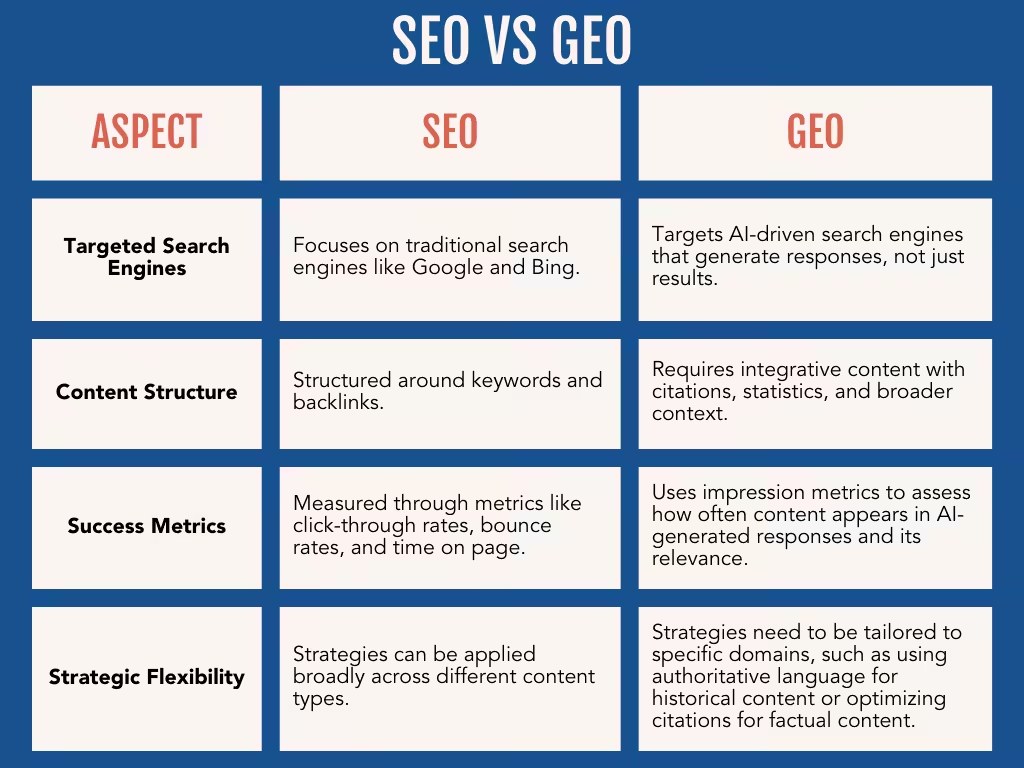
At first blush, GEO sounds similar to SEO with a twist — the difference is fundamental:
- Old school SEO: Obsesses over keywords, backlinks and metadata for a higher SERP positioning.
- Generative Engine Optimization: Concentrates on organizing, wording, and defining content in such a way that AI is likely to pull, and showcase content as an authoritative source.
- Think about it: With SEO, you can rank your blog post on the first page of Google. Using GEO, that very blog post could be the specific source that AI references in a conversational answer, giving your brand a louder voice to millions.
That one little letter that shift from SEO to GEO is a monumental step in how brands should be thinking about digital strategy.
Why user behavior demands GEO?
Today’s users want fast, clear answers without wasting time jumping from one website to another.
Instead of scrolling through long pages, they prefer AI tools that can quickly pull information together and give them a simple summary in one place.
Because of this shift, Generative Engine Optimization depends heavily on trust, clear citations, and strong content authority.
AI systems are more likely to use content that looks reliable, well-structured, and easy to understand.
This creates a new reality for businesses. It is no longer just about ranking on search engines. It is about being included in AI-generated answers.
If your content is not seen as useful or credible enough, it may not appear at all in these summaries.
So, GEO is both a challenge and an opportunity.
The challenge is that competition is growing and AI tools are selective about what they show. The opportunity is that brands that get it right can gain visibility without relying only on traditional search traffic.
Key strategies for effective GEO
The process of generative engine optimization requires you to change your content and technical strategy and tactics. However, in addition to structured data and intelligent or purposeful writing, the established good practices are not lost.
Backlinks are important, as a means of not only providing credibility but also to the search and generative engines that your content is trusted and largely referred to.
Here are the best strategies:
1. User-intent-centered
The Generative AI sings well in context and with purpose. Ask a question: What problem are my audience seeking to solve? What is the deeper motive of their inquiry?
As an example, when a user wants to understand the best CRM tools, they may not necessarily need a list, they may want comparisons, pricing specifications and use cases.
GEO will ensure that your content meets the intent of an entire query.
2. Use AI-friendly structured data
Schema markup is like a blueprint to the AI engines -this construct assists engines in comprehending your information. By tagging your content with information about products, reviews, FAQ or events, you help AI systems to digest and integrate your information.
An example is that a structured-data-recipe blog would have better chances of being quoted by an AI that creates a list of “quick dinner recipes”.
3. Create conversational, easy-to-read content
Human speech is fed to the AI dialogue models. There is a greater likelihood that the content that is linked sounds like real conversation.
That implies avoiding lengthy sentences, using active voice, and the use of easy language. Think of your content being read aloud in a way that makes sense–that is what will perform best with generative engines.
4. Use unique and special language
The input format of AI systems eliminates repetitive or duplicated phrases. The distinctive words, new metaphors, and very specific words make your text unique.
Rather than, say, saying, “SEO helps to increase your rankings.” you could add, “SEO provides the digital breadcrumbs that guide users toward your site.” It is that quality of uniqueness that makes it appealing to the AI.
5. Optimize for AI summaries
Clarity is a great friend to Generative engines. Putting your content in bullet points, numbered lists or short explanatory paragraphs makes it easier to extract structured insights by the filter.
As an example, any answer to a query like “What is the difference between GEO and SEO?” in the form of a short bulleted list would be more likely to be quoted than one that is not.
6. Refresh and update regularly
AI models constantly devour new data that is new Older posts can be disregarded based on newer ones. The change of the articles with the latest stats, trends and examples signalizes the fact of the relevance.
5 main benefits of Generative Engine Optimization (GEO)
Businesses can benefit in several clear ways by using Generative Engine Optimization strategies. But here are the main 5:
1. Increased visibility inside AI answers
With GEO, your content can appear directly inside AI responses when people ask questions about your industry.
This is different from traditional SEO where users still have to click a link. Here, your brand becomes part of the answer itself.
That gives you more exposure without needing extra ads or clicks. Even small pages can get visibility if the content is clear and useful.
2. Stronger trust when AI mentions your brand
When an AI tool includes your content or brand in its answers, people tend to see it as more reliable.
It feels like a quiet approval. Over time, this builds trust because users start to recognize your name as something AI often references.
That repeated exposure helps your brand feel more solid and dependable.
3. Staying ahead as search keeps changing
Search is not what it used to be. More people are asking questions directly from AI tools instead of typing keywords into Google.
GEO helps you adjust to that shift early. Instead of waiting to lose traffic, you start building content that fits how people now search and how AI now responds.
4. Better engagement from real user intent
GEO focuses on answering questions clearly, not just stuffing keywords. That means your content is more aligned with what users actually want to know.
When people find answers that match their intent, they are more likely to stay, read more, or take action. It’s less about traffic tricks and more about usefulness.
5. Stronger brand recall and long-term loyalty
When people keep seeing your brand inside different AI answers, it sticks. Even if they don’t click right away, they remember you.
Over time, that repeated exposure builds familiarity. And familiarity often turns into trust, and trust often turns into long-term customers.
The business case for GEO adoption
Implementing GEO means not only keeping up with the times; it means realizing a new growth potential.
- According to a McKinsey research, sales ROI is increasing by 10-20 percent in companies investing in AI.
- GEO also provides visibility on AI-based (such as ChatGPT, Gemini, or Perplexity) product recommendations, conversational search results, and business knowledge panels.
- The brand authority and organic traffic may be increased significantly by being mentioned as a trustful source of information in generative engines.
In simple terms: where SEO is about ranking higher, GEO is about being the voice of authority in the AI conversations.
Key challenges of Generative Engine Optimization (GEO)
Generative Engine Optimization is powerful, but it is not simple. It comes with real challenges that can affect how well your content performs inside AI tools.
If you understand these issues early, you can plan better and avoid wasting effort.
1. AI tools change too fast to rely on one method
AI platforms like ChatGPT, Gemini, and Copilot are updated often. What helps your content get picked today might not work the same way next month.
This makes GEO unstable in some ways. You cannot set a fixed strategy and forget it. You need to keep testing and adjusting your content as these tools evolve.
2. More brands are competing for the same AI space
GEO is still new, but it is growing fast. More businesses are now trying to get their content into AI answers.
This means competition is increasing every day. Simple or generic content will not stand out for long. You will need to create content that is clearer, more useful, and sometimes more original to stay visible.
3. It is hard to measure real results
Traditional SEO is easy to track. You can check rankings, clicks, and impressions.
GEO is different. You may not always know when your content is used inside an AI answer.
This makes it harder to measure success. New ways of tracking will matter more, like checking when your brand is mentioned or how often AI tools reference your content.
4. Attribution is not always clear or fair
Sometimes AI tools will use your content to form answers, but your brand may not be clearly shown.
This creates a problem. Your work is being used, but users may not know where it came from. That can affect credit and recognition.
Businesses will need to think carefully about how to balance visibility with proper credit.
The future of GEO
The generative engine optimization is still in its infancy, but trends suggest rapid growth. Here’s what the future may bring:
- Seamless support of voice assistants: Articles written in a GEO format could serve as answers for Alexa, Siri or Google Assistant.
- More personalization: AI engines will use user behavior to further personalize answers, so businesses will need to develop flexible, audience-focused content.
- Emergence of AI-first search engines: There may be new search engines that focus on an AI search model instead of a link-based (or the traditional) search model.
Just as SEO was unavoidable 20 years ago, so will GEO be in digital strategy.
How to get started with GEO?
- Audit your current content: Find that middle ground between lackluster (or nonexistent) writing and overwhelming perfection.
- Add structured data: Employ schema to assist AI in understanding your content on a more precise level.
- Rewrite to clarify and differentiate: Eliminate jargon and establish a clear brand voice.
- Track AI citations: Track whether your output shows up in AI products with monitoring tools.
- Invest in GEO knowledge: Surround yourself with teammates who know local AI-first search landscapes.
- Focus on credibility: Use reliable sources, original insights, and display knowledge.
- Test conversational content: FAQ, Q&A, and explainer-type blogs are effective with AI summarization.
For example, when a business blog implemented schema and conversational summaries to enhance its product comparison pages, its content increasingly appeared in AI-generated answers to questions in Bing Copilot and Google AI Overview pages.
Frequently asked questions about GEO
1. Is GEO replacing SEO?
No SEO is still relevant, but GEO adds to it. Consider GEO as that next frontier of digital visibility—here is where you get AI activity, not merely ranked in search.
2. How can I ensure that my content is GEO-friendly?
If you are writing clear, conversational, organised content that is aligned with user intent, then your content will be more likely to be used by generative engines.” Structured data can help more, of course.
3. Is GEO suitable for Small businesses?
Yes. In actuality, GEO is the great equalizer. In AI-led search outputs the playing field is level, smaller brands with clear, niche content output can compete with big brands.
4. How frequently should I refresh my GEO content?
That’s a minimum starting point — quarterly updates are better than nothing. The fresher, the more relevant and the more accurate the data you provide, the higher the chance that your content will be used as reference by Artificial Intelligence sitting on top of it.
5. Which are the biggest GEO consumers?
None of the industries is totally immune to it, but when you work in GEO, it can be especially pronounced for industries as diverse as e-commerce, SaaS, healthcare and finance, where direct, authoritative answers are in demand.
6. Can GEO and SEO strategies be used together?
Yes. They complement each other. Your SEO is what establishes a foundation of discoverability for search engines, and your GEO assures your content is ready to be surfaced in AI-driven responses.
7. What kind of content works best for GEO?
Content that is clear, factual, well-structured, and written to answer real questions directly. Prioritizing long-form keywords, a conversational writing style, and well-cited information can help AI models better understand the context and credibility of your content. Thin or vague content rarely gets picked up.
8. How do you know if GEO is working?
Track citations in AI responses, brand mentions in generated content, referral traffic from AI platforms, and conversion rates from AI-referred visitors rather than relying only on traditional ranking metrics. If your brand starts showing up in AI answers, that’s a strong sign it’s working.
Final Thoughts
Generative engine optimization is not only the future: it already is the present.
Companies that have stuck to conventional SEO may get blind sided by how AI transforms the way we search and identify what we are seeking.
There are GEO best practices that you can implement today so you can be assured that your brand will be the voice AI engines trust.
Ready to lead in the AI-first digital world? Stop and see the https://blockagency.co/ to get on your way.